
Modular Data Acquisition System for Structural Vibration and Strain Testing at NOVA FCT
24 high-resolution measurement channels for experimental vibration and strain testing, built on an open, modular and scalable platform with the potential to support future real-time signal processing and control applications.

PerfectDecibel, the Portuguese representative of Gantner Instruments, has supplied an advanced modular data acquisition system to the Department of Mechanical and Industrial Engineering (DEMI) at NOVA FCT – NOVA University Lisbon, for its Structural Mechanics Laboratory at the Caparica Campus, Portugal.
The system combines dynamic signal acquisition, strain measurement and dedicated data acquisition software, providing a total of 24 high-resolution measurement channels.
Designed for experimental structural testing, the solution supports measurements using IEPE (ICP) triaxial accelerometers, an instrumented impact hammer and strain gauges, enabling researchers to investigate the dynamic response and mechanical deformation of structures and components.
Beyond its current laboratory applications, the Gantner Instruments architecture provides a flexible foundation for future research projects, including advanced signal processing, real-time monitoring and control.
System Configuration – 24 Measurement Channels
Photographs courtesy of Prof. Tiago Silva – Structural Mechanics Laboratory (DEMI), NOVA FCT, Portugal
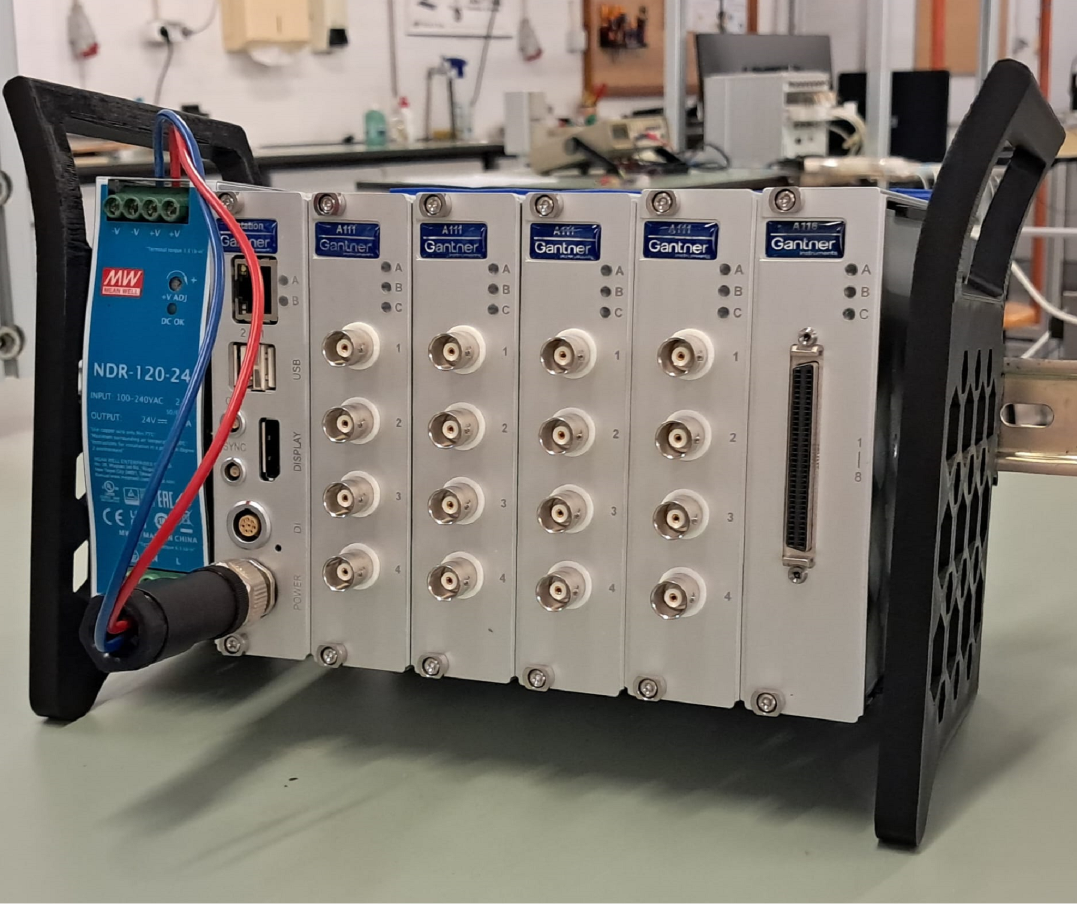
The Gantner Instruments solution supplied to NOVA FCT includes the following components:
Q.station XB (1 unit) – Data Acquisition Controller
The Q.station XB is a high-performance data acquisition controller featuring an embedded processor and a Real-time Linux operating system. It supports two main operating modes:
PC-connected acquisition: Ethernet communication with an external computer for system configuration, data visualization and recording.
Standalone operation: Autonomous data acquisition and local processing without requiring a permanently connected computer.
This flexibility allows the same platform to support conventional laboratory measurements and more advanced autonomous acquisition applications.
Q.bloxx XL A111 BNC (4 units) – Vibration Measurement (total: 16 channels)
Each Q.bloxx XL A111 BNC module provides four analog input channels suitable for IEPE (ICP) sensors and voltage measurements.
Key specifications:
4 channels per module, providing 16 channels in total
24-bit analog-to-digital conversion
Simultaneous sampling rates up to 100 kHz per channel
BNC input connectors
Support for IEPE sensors and voltage signals
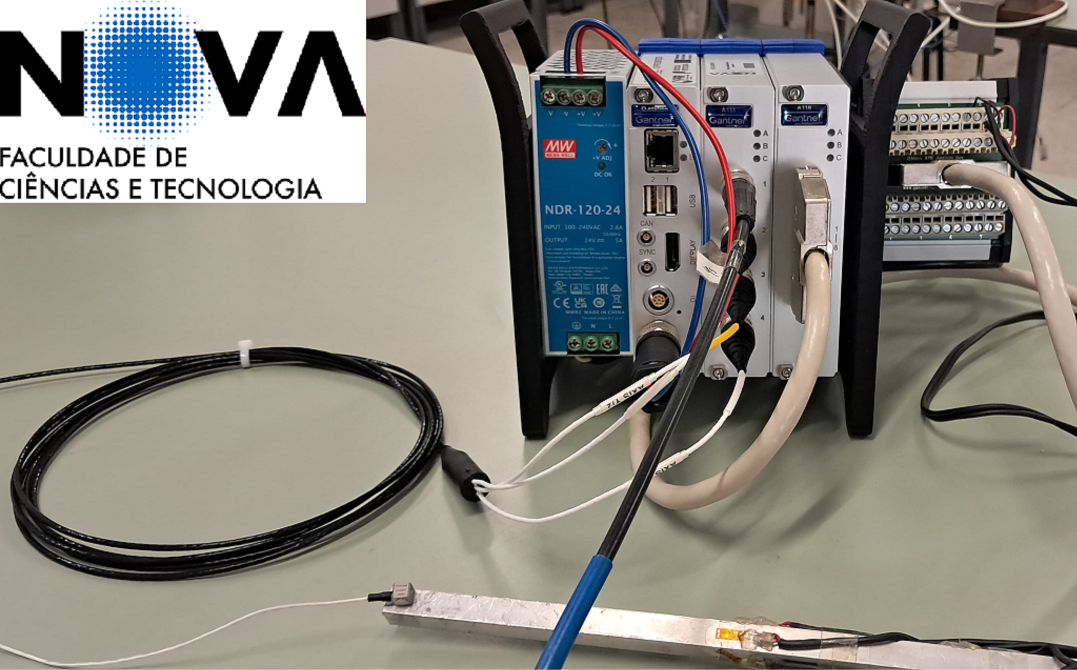
At the NOVA FCT Structural Mechanics Laboratory, these modules are intended for vibration testing using multiple triaxial accelerometers and an instrumented impact hammer.
This configuration enables the simultaneous acquisition of multiple dynamic signals, supporting experimental investigations into the vibrational behavior of structures and mechanical components.
Q.bloxx XL A116 (1 unit) – Strain Measurement (total: 8 channels)
The Q.bloxx XL A116 provides eight analog measurement channels designed for strain gauge applications.
Key specifications:
8 measurement channels
24-bit analog-to-digital conversion
Simultaneous sampling rates up to 20 kHz per channel
Support for strain gauge measurements
Dedicated connection cable and terminal block
This module complements the vibration measurement channels, allowing researchers to investigate structural deformation under different experimental loading conditions.
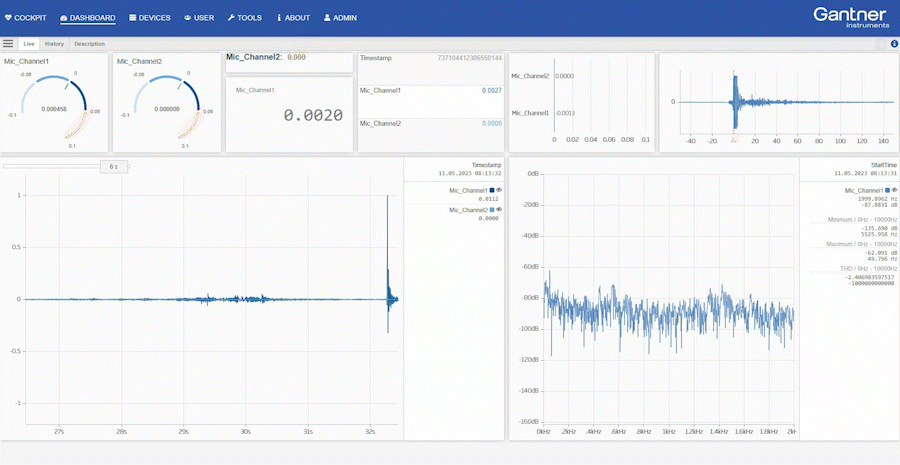
GI.bench – Data Acquisition and Visualization Software (perpetual license)
GI.bench is Gantner Instruments' software platform for configuring, visualizing and recording measurement data through a graphical interface, without requiring programming. Its main capabilities include:
Measurement channel configuration
Data acquisition and visualization
Measurement data recording
Data analysis and presentation tools
Integration with the modular Gantner Instruments hardware platform
The perpetual license provides continued use of the licensed software without an annual subscription requirement.
From Data Acquisition to Real-Time Processing and Control
The Gantner Instruments architecture offers capabilities that extend beyond conventional data acquisition.
Q.station controllers, equipped with Real-time Linux, can execute customized signal processing and analysis algorithms directly on the controller, reducing dependence on external computers for certain processing tasks.
For advanced applications, algorithms developed in C/C++, including code generated from MATLAB/Simulink models, can be integrated into the Q.station environment using the mechanisms provided by Gantner Instruments.
Learn more about MATLAB/Simulink integration with Q.station.
These capabilities open opportunities for advanced research and industrial applications, including:
Real-Time Signal Processing
Structural Health Monitoring (SHM)
Condition Monitoring
Predictive Maintenance
Real-Time Control
Hardware-in-the-Loop (HIL)
Future Research Opportunities at NOVA FCT
The Gantner Instruments system supplied to the NOVA FCT Structural Mechanics Laboratory was initially acquired for experimental vibration and strain measurements. However, the Q.station XB controller provides a technological foundation that may also support advanced signal processing and real-time control applications in future research projects.
These additional capabilities are not part of the laboratory application described in this project. They represent potential future developments that can be explored using the existing Gantner platform, subject to the technical requirements of each application. This ability to evolve from conventional data acquisition to more advanced processing and control functions is particularly valuable in academic environments, where research objectives and experimental requirements may change over time.
By combining high-performance data acquisition, open interfaces, modular hardware and local processing capabilities, Gantner Instruments provides a flexible technological foundation for both academic research and advanced industrial testing. This approach helps facilitate the transfer of engineering knowledge and innovation from universities and research laboratories to practical industrial implementation.
Acknowledgment to NOVA FCT
PerfectDecibel would like to thank Professor Tiago Silva, from the Department of Mechanical and Industrial Engineering (DEMI) at NOVA FCT, for the confidence placed in Gantner Instruments technology.
We also sincerely appreciate his contribution in sharing photographs of the system installed at the Structural Mechanics Laboratory.
This project represents another example of advanced data acquisition technology supporting engineering education, experimental research and scientific development in Portugal.
PerfectDecibel is pleased to contribute to the continued development of measurement and testing capabilities within Portuguese universities and research institutions.